
After years of working for himself, Han knew exactly what he wanted from his next career move. Sqills happened to be building it. Ten years, several teams, and one non-negotiable commute later, he continues to work at Sqills.
Han
Meet Han - After years of working for himself, he knew exactly what he wanted next. A decade later, he is a development lead and still building the product he came for.
How did you end up at Sqills?
Running my own company for a long time taught me what I liked and what I didn't. Client contact had started to wear thin after doing it for years. What I really wanted was the freedom to make long-term investments in something. That pointed me toward product development. Project work is always short-term, with the budget or the deadline pulling at you the whole time. Product development gives you the room to build something properly and see it grow into something real.
Sqills was building S3 Passenger at the time, which overlapped with what I had been working on. Getting on that train, literally, felt like it could be a lot of fun.
I also had a hard requirement for my next job: I wanted to cycle to work from Enschede or Hengelo, with no more than half an hour of commuting. That ruled out a lot of places. Beyond that, I was looking for a software company with a positive feel, one that wanted to keep developing its technology. Sqills fit, so I applied, and clearly they saw something in me as well.
Early on I wasn't put straight onto S3 Passenger. I did some device service work and an Arriva app first. I flagged pretty quickly that product development was where I wanted to be, and within about three months I was working on S3 Passenger. I have been part of that whole journey since. All the way from a single customer to where we are now, through every scaling issue we have run into and fixed along the way. Watching something grow from scratch is the part I love most.
What does a typical week look like?
These days I am a development lead, so I am a bit closer to the software architecture than to the code itself, though I would still say 70 to 80 percent of my week is coding-related. The rest goes to team coaching, compliance, and whatever initiatives I think are worth pushing forward.
I have more meetings than a typical developer, around eight hours in a 32-hour week, so roughly a quarter of my time. That comes with working across teams rather than only working inside my own. A lot of the coaching side is simple in principle: check to make sure people are happy, look at where the team is getting stuck, and figure out how to fix or automate it. The deeper, vision-level problems are the ones I find most satisfying to solve.
"The thing that genuinely surprised me came when I was ill for a long stretch, close to two years, with a full year away from work entirely. Sqills handled it with real care and stood behind me as a person the whole way through. I am grateful for that, and I think it matters tremendously."
What surprised you about working here?
When I started ten years ago, the feeling was very much "together, we'll make this work." Everyone helped each other out, and there was a lot of room to do that.
The thing that genuinely surprised me came when I was ill for a long stretch, close to two years, with a full year away from work entirely. Sqills handled it with real care and stood behind me as a person the whole way through. I am grateful for that, and I think it matters tremendously.
The other thing is that initiative tends to be welcomed here. When I have an idea, I usually get to try it. That suits me well.
What keeps you here?
Honestly, the commute is still part of it. Working within cycling distance gives me the flexibility to manage family life properly. Beyond that, it is the appreciation and the freedom to work on what I think matters, as long as it contributes to S3 Passenger.
And the long-term investment side still holds. I can make those one, five, or ten percent improvements that quietly compound over the years. That is what makes the difference in the end, and I find it genuinely rewarding.
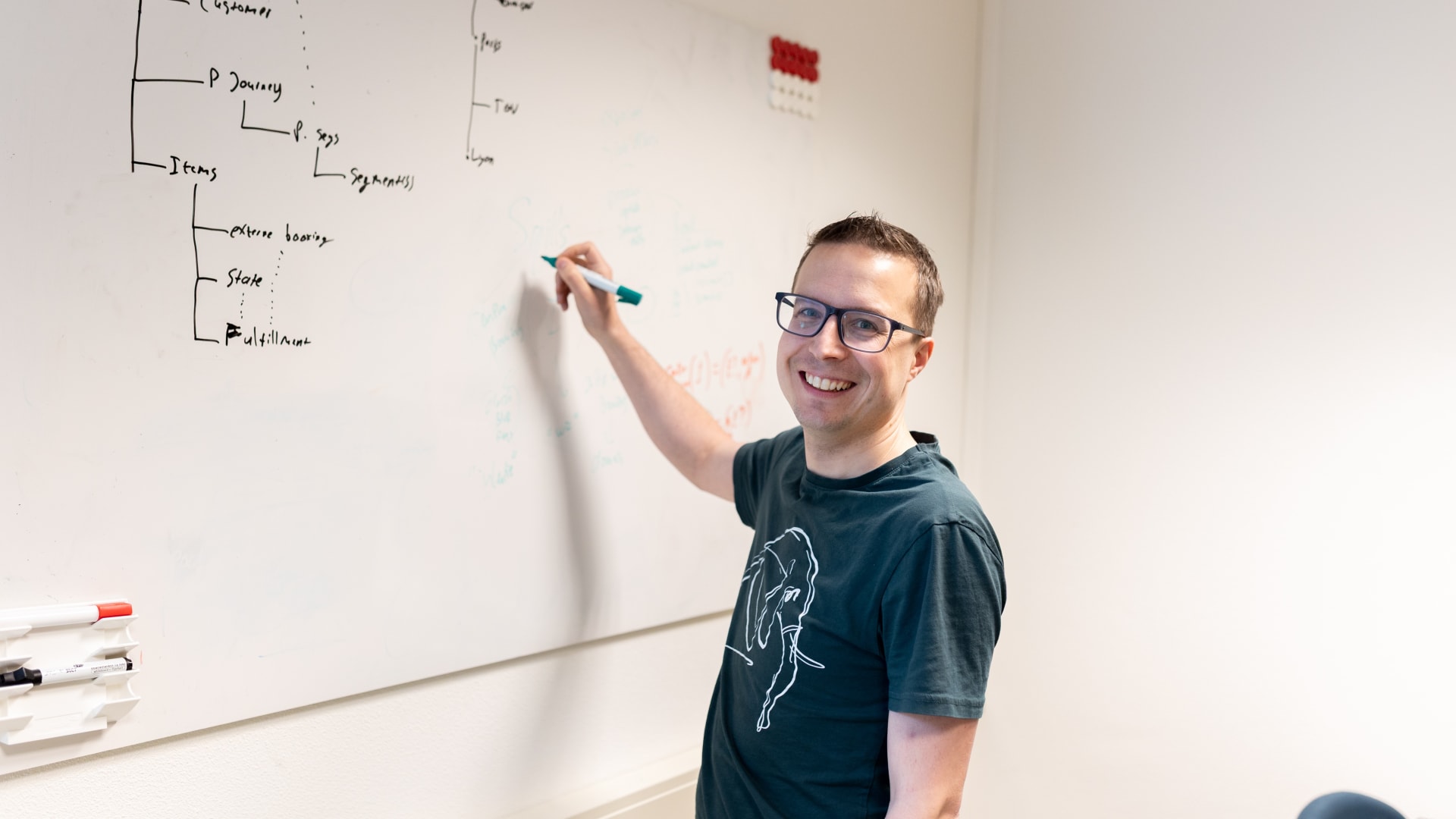
"You can just be yourself here, and that is good enough."
What should someone know before they apply?
I recently did an Alumni Career Café at the University of Twente, mostly with people who had just graduated or were about to. They asked very practical things: how the application process works, what we look at, what to do about a gap in a CV.
My advice was the same for all of them. Be honest and open. If you have a gap, explain why and how. If you were ill, that is fine. If you took a year and did nothing, that is fine too. Don't present yourself as more than you are. Stay positive, proactive, and helpful, and bring a bit of humility. That works for any company you apply to, not only this one.
If you oversell yourself, you will get caught out eventually. Most people want to work alongside others who are honest, proactive, and willing to admit they can't do everything. One of my colleagues put it well: the surprising thing about Sqills is that you can just be yourself here, and that is good enough.
It is something I emphasise in my own team too. It comes down to you as a person. Software is what we happen to deliver, and when you are happy, productivity follows.
Want more?
Want to apply to start creating your own story at Sqills? Want to read more from other colleagues? Click below